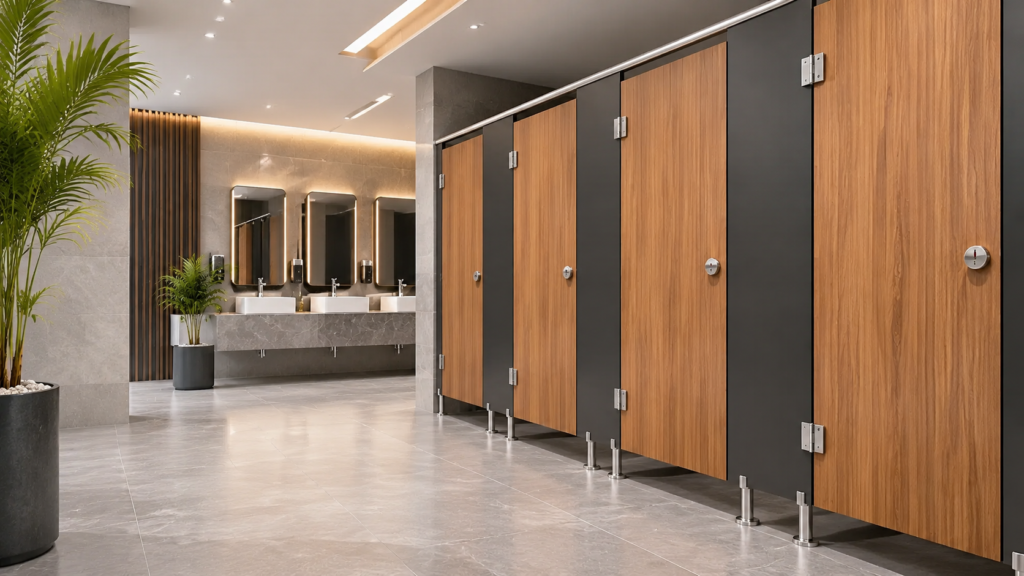
Commercial washrooms are among the most frequently used areas in hotels, shopping malls, schools, hospitals, offices, restaurants, and public facilities. Toilet cubicles must provide privacy, withstand frequent use, maintain their appearance, and tolerate continuous cleaning and exposure to moisture.
Choosing the wrong cubicle material can lead to rust, swelling, damaged finishes, loose fittings, maintenance problems, and costly replacements.
High Pressure Laminate (HPL) compact laminate has become one of the preferred materials for modern toilet cubicle systems because it offers a combination of durability, moisture resistance, impact resistance, hygiene, and design flexibility.
For commercial projects in Muscat and across Oman, HPL toilet cubicles are a practical solution for washrooms where long-term performance and appearance are important.
- What Is HPL Compact Laminate for Toilet Cubicles?
HPL compact laminate is manufactured by pressing multiple layers of resin-impregnated paper under high pressure and temperature to create a dense, solid panel.
Unlike conventional laminated boards, compact laminate is self-supporting and does not require a particleboard or MDF core.
It is commonly used for:
- Toilet cubicle partitions.
- Cubicle doors.
- Privacy partitions.
- Shower partitions in suitable applications.
- Urinal screens.
- Changing room partitions.
- Washroom accessories and selected furniture components.
Its solid construction makes it particularly suitable for commercial washroom environments where moisture and frequent use are expected.
- Why Moisture Resistance Is Essential in Washrooms
Washroom cubicles are continuously exposed to water, humidity, cleaning chemicals, and wet floors.
Materials that rely on wood-based substrates can be vulnerable when water enters through edges, joints, drilled holes, or damaged surfaces.
Moisture can lead to:
- Swelling of the substrate.
- Edge deterioration.
- Surface peeling or delamination.
- Changes in panel shape.
- Deterioration of fixings.
- Premature replacement.
HPL compact laminate is a solid panel designed for moisture-exposed applications. It does not have the conventional wood-based core found in many laminated boards.
This makes it a strong choice for washroom partitions, provided the system is correctly designed and installed.
- HPL vs Metal Toilet Cubicles: The Problems with Metal
Metal toilet cubicles are often selected because of their initial cost or industrial appearance. However, metal systems can face challenges in wet and heavily used washroom environments.
Common disadvantages of metal cubicles
Rust and corrosion
Painted steel may corrode when its protective coating is damaged, particularly in wet environments or around edges, joints, drilled holes, and fixings.
Scratches and damaged coatings
Scratches, dents, or impact damage may expose the underlying metal or affect the finish, requiring repair or repainting.
Dents and deformation
Thin metal panels can dent when subjected to impact, vandalism, or rough use.
Fingerprints and marks
Some metal finishes, particularly stainless steel, can show fingerprints, smudges, water marks, and scratches.
Limited design warmth
Metal can provide a clean industrial appearance, but may not deliver the same decorative warmth and variety available through compact laminate colors, patterns, and textures.
Why HPL is a better choice for many commercial washrooms
HPL compact laminate offers:
- No rusting of the panel itself.
- Strong impact resistance.
- A solid panel construction.
- A broad range of colors and finishes.
- A more decorative appearance.
- Practical cleaning and maintenance.
- Suitable performance for high-traffic washroom environments.
Metal can still be appropriate for specialized applications, but HPL offers a particularly attractive balance of performance and aesthetics for commercial toilet cubicles.
- HPL vs Wood and MDF Toilet Cubicles
Wood-based panels, MDF, and laminated boards are commonly used in interior furniture. However, conventional wood-based products are generally less suitable for washroom cubicles exposed to frequent moisture.
Common disadvantages of wood-based cubicles
Water absorption
Water can penetrate exposed edges, joints, damaged laminates, and fixing holes.
Swelling
When the substrate absorbs moisture, it may expand, affecting panel dimensions and appearance.
Delamination
Decorative layers may separate from the substrate when moisture reaches the adhesive or underlying board.
Damage to edges
Edges are particularly vulnerable to impact and moisture penetration.
Higher maintenance
Damaged surfaces may require repairs, sealing, or replacement.
Why compact laminate is the better solution
HPL compact laminate is manufactured as a solid, self-supporting panel rather than a decorative layer bonded to a wood-based core.
Its benefits include:
- Greater suitability for wet washroom environments.
- No conventional MDF or particleboard core.
- Reduced risk of moisture-related swelling.
- Durable solid panel construction.
- Better suitability for demanding commercial applications.
- No need for decorative edge banding on the panel in the same way as wood-based boards.
For washrooms with frequent daily use, compact laminate provides a more reliable material solution than conventional laminated wood boards.
- Durability for High-Traffic Washrooms
Commercial toilet cubicles are used repeatedly throughout the day. In facilities such as malls, schools, airports, hotels, and office buildings, the partitions must withstand continuous operation.
HPL compact laminate provides a durable surface suitable for intensive use.
It offers practical advantages against:
- Daily wear.
- Accidental impact.
- Scratches from everyday contact.
- Frequent cleaning.
- Moisture exposure.
- General use in busy facilities.
Material durability must be supported by appropriate hardware, correct fixing details, and professional installation.
- Hygiene, Cleaning & Maintenance
Washroom hygiene is a major consideration for facility managers.
HPL cubicle surfaces are generally easy to clean using appropriate non-abrasive cleaning products and routine maintenance procedures.
Good cubicle design should minimize dirt-collecting details and ensure that the panel surfaces and hardware can be accessed for cleaning.
Maintenance recommendations include:
- Routine cleaning with approved detergents.
- Avoiding abrasive materials that may damage the surface.
- Prompt removal of stains.
- Regular inspection of hinges and locks.
- Checking brackets, supports, and fixing points.
- Replacing damaged hardware when required.
A properly maintained HPL cubicle system can retain its appearance and functionality over many years.
- Design Options for Modern Commercial Washrooms
One of the major advantages of HPL compact laminate is its design versatility.
Available design options can include:
- Solid colors.
- Wood-inspired finishes.
- Stone-inspired patterns.
- Contemporary decorative finishes.
- Different surface textures.
- Coordinated color schemes.
Architects and designers can use these finishes to match the washroom’s overall interior concept.
HPL cubicles can be designed for different configurations, including floor-mounted systems, elevated systems, and other layouts depending on project requirements and approved hardware systems.
- Hardware & Accessories Matter
A toilet cubicle is a complete system—not just a panel.
The quality of hinges, locks, brackets, supports, legs, and accessories plays a major role in its performance.
A complete system may include:
- Stainless steel hinges.
- Occupancy locks and indicators.
- Door handles.
- Coat hooks.
- Support legs.
- Brackets.
- Headrails where applicable.
- Emergency release mechanisms.
For wet and high-use environments, the correct grade of hardware should be selected to suit the operating conditions.
- Where HPL Toilet Cubicles Are Used in Oman
HPL toilet cubicles are suitable for a wide range of projects across Muscat and Oman, including:
- Shopping malls.
- Hotels and resorts.
- Schools and universities.
- Hospitals and clinics.
- Corporate offices.
- Restaurants and cafés.
- Sports facilities.
- Airports and transport facilities.
- Industrial and staff washrooms.
- Government and institutional buildings.
The material can be specified to suit different design requirements, traffic levels, and budgets.
- Why Choose Modon Business for HPL Toilet Cubicles in Muscat?
Selecting a specialist HPL contractor helps ensure that the cubicles are correctly measured, designed, fabricated, coordinated, and installed.
Modon Business specializes in HPL compact laminate toilet cubicles and provides solutions for commercial and institutional projects in Muscat and throughout Oman.
Our services include:
- Site measurements and coordination.
- Cubicle layout planning.
- Material and color selection.
- Shop drawings.
- CNC cutting and fabrication.
- Supply of hardware and accessories.
- Installation and alignment.
- Quality inspection and handover.
We work with contractors, consultants, developers, and project owners to deliver washroom cubicle solutions designed for the specific needs of each project.
Conclusion
HPL compact laminate is one of the best choices for commercial toilet cubicles because it offers moisture resistance, durability, impact resistance, design flexibility, and practical maintenance.
Compared with conventional wood-based boards, it avoids the vulnerabilities associated with moisture absorption and substrate swelling. Compared with painted metal, it avoids panel rusting and coating-related corrosion while offering a wider range of decorative finishes.
For modern washrooms in Muscat and Oman, HPL compact laminate provides a durable, attractive, and functional solution.
Modon Business is your specialist partner for HPL toilet cubicles, delivering professional fabrication, hardware solutions, and installation for commercial projects.