Choosing the right exterior cladding material is one of the most important decisions in modern building design. A façade is not simply the exterior appearance of a building—it is a long-term investment that must withstand environmental exposure, maintain its appearance, meet technical requirements, and remain practical to maintain.
In Oman, particularly in Muscat, buildings are exposed to intense sunlight, high temperatures, dust, seasonal rain, and challenging outdoor conditions. Architects, developers, consultants, and contractors must therefore select façade materials that balance aesthetics, durability, installation requirements, and long-term value.
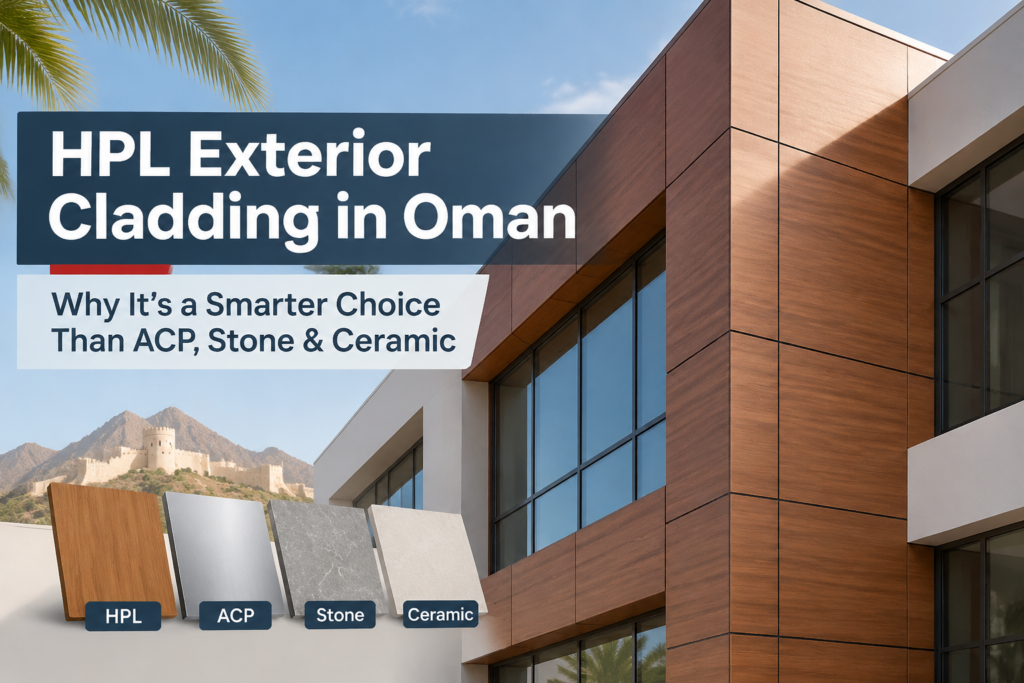
High Pressure Laminate (HPL) exterior compact panels have become a popular architectural option for modern façades, offering a combination of decorative flexibility, impact resistance, relatively lightweight construction, and practical maintenance.
But why choose HPL over Aluminium Composite Panels (ACP), stone, or ceramic cladding?
- What Is Exterior HPL Cladding?
Exterior HPL compact laminate is manufactured by pressing multiple resin-impregnated layers under high pressure and temperature to produce a dense, durable panel with a decorative exterior surface.
Exterior-grade HPL panels are specially manufactured for outdoor use and incorporate surface technology intended to withstand UV exposure and weathering. They are available in a variety of colors, textures, patterns, and finishes, including wood-inspired, stone-inspired, and solid-color designs.
HPL cladding can be used in:
- Commercial buildings
- Residential villas and developments
- Hotels and hospitality projects
- Schools and educational facilities
- Office buildings
- Retail spaces
- Feature façades and architectural accents
- Soffits and selected exterior applications
Exterior-grade panels must be used for outdoor applications; interior HPL is not a substitute for exterior compact laminate.
- Why HPL Is an Excellent Choice for Oman’s Climate
Buildings in Oman face challenging environmental conditions, making material selection especially important.
Resistance to sunlight and UV exposure
Exterior-grade HPL is manufactured with a weather-resistant surface designed to help protect its decorative finish from prolonged outdoor exposure. This is important for façades exposed to direct sunlight throughout the year.
Resistance to moisture
Compact HPL panels have a dense construction and are resistant to moisture. They do not rust like metal, and they do not have a wood-based substrate that can swell when exposed to moisture.
Resistance to impact
HPL compact panels are mechanically robust and offer good impact resistance, making them suitable for locations where façade surfaces may be exposed to accidental contact or physical impact.
Practical cleaning and maintenance
Dust and environmental deposits are inevitable in Oman. HPL cladding can generally be cleaned with suitable cleaning methods recommended by the manufacturer, helping building owners maintain their façades without complicated treatment procedures.
- HPL vs ACP Cladding: Why Surface Durability Matters
Aluminium Composite Panels (ACP) consist of aluminium skins bonded around a core. They are lightweight, offer a smooth appearance, and can be fabricated into folded shapes, making them suitable for many architectural applications.
However, ACP has certain considerations:
- The exterior coating may be susceptible to scratches and surface damage.
- Dents can affect the appearance of the aluminium surface.
- Damage to the coating may expose the underlying material.
- Different ACP core types have different fire-performance characteristics and must be carefully specified.
- Fabricated joints, folds, edges, and corners require careful detailing.
Exterior HPL offers a different advantage: its dense compact panel construction and decorative surface provide a durable architectural finish with good resistance to everyday impact and surface wear.
HPL is particularly attractive for façades requiring wood, stone, or textured appearances without using actual timber or heavy natural stone.
ACP may still be the better choice where the design requires folded cassette panels, curved details, metallic finishes, or specific lightweight fabrication solutions. The best choice depends on the façade design and technical specification.
- HPL vs Natural Stone: Reducing Weight and Installation Complexity
Natural stone offers a premium architectural appearance and excellent longevity when properly selected, designed, and installed. However, stone cladding comes with several project considerations.
Disadvantages and challenges of stone cladding
- High material weight, requiring substantial structural support.
- More complex handling and lifting during installation.
- Higher demands on anchoring and support systems.
- Potential cracking, chipping, or damage during handling and installation.
- Natural variations in color, veins, and patterns.
- More complicated cutting and fabrication.
- Greater structural loads on the building façade.
HPL compact cladding provides a much lighter alternative to many natural stone systems. Its lighter weight can help simplify handling and reduce the demands associated with supporting heavy façade materials.
HPL also offers more predictable decorative finishes, making it easier to coordinate panels across a project when consistent colors and patterns are required.
Stone remains an excellent choice for projects where authentic natural material, a particular fire classification, or a specific architectural appearance is essential. HPL is a practical alternative where weight, design flexibility, installation efficiency, and durability are priorities.
- HPL vs Ceramic Cladding: Handling, Impact & Practical Installation
Ceramic and porcelain façade panels are popular for their hard surfaces, excellent weather performance, and strong fire characteristics.
However, ceramic cladding can present challenges:
- Panels can crack or break if subjected to impact.
- Handling requires care, particularly with large-format panels.
- Cutting and drilling require specialized tools and techniques.
- Breakage during transportation or installation can result in material waste.
- Some systems require specific backing, support, or fixing arrangements.
- Replacement of damaged panels may require careful matching and access.
HPL compact panels are generally easier to machine and handle than many ceramic façade products and offer good impact resistance for appropriately designed applications.
The material’s strength and flexibility in fabrication make it suitable for projects where panels need to be cut to specific dimensions and coordinated with architectural openings, corners, and façade details.
Ceramic can be the better choice where non-combustible façade materials or specific technical requirements are mandatory. HPL should always be selected according to the approved fire classification and building requirements.
- Design Freedom: Colors, Textures & Architectural Finishes
One of the biggest advantages of HPL cladding is its decorative versatility.
Architects and designers can choose from:
- Natural wood-inspired finishes
- Stone-inspired patterns
- Concrete-inspired textures
- Solid colors
- Contemporary architectural finishes
- Selected textured surfaces
These options allow designers to create distinctive façade designs while using a consistent panel material.
HPL can be used for complete façades, feature walls, entrance areas, façade bands, and selected architectural details, helping create a cohesive design language throughout the building.
- Installation & Technical Considerations
The performance of an HPL façade depends not only on the panel itself but also on the installation system.
Important considerations include:
- Correct exterior-grade panel selection.
- Panel thickness and dimensions.
- Structural support and subframe design.
- Fixing type and spacing.
- Allowance for thermal and moisture-related movement.
- Ventilation and drainage behind panels where required.
- Edge distances and drilling details.
- Wind-load calculations.
- Fire classification and complete façade-system compliance.
Incorrect installation can lead to panel deformation, stress around fixings, or premature performance issues. Proper technical design and installation are essential.
- Why Choose Modon Business for HPL Exterior Cladding in Muscat, Oman?
Selecting the right material is only one part of a successful façade project. The contractor’s experience in fabrication, coordination, technical detailing, and installation is equally important.
Modon Business specializes in HPL compact laminate solutions, supporting projects from material selection and design coordination through fabrication and installation.
Our exterior cladding services include:
- HPL material selection and finish coordination.
- Technical review and project coordination.
- Shop drawings and panel layout planning.
- Panel cutting and fabrication.
- Coordination of fixing and support systems.
- Site installation.
- Quality inspection and project handover.
For developers, architects, consultants, and contractors in Muscat and across Oman, Modon Business provides specialist support for exterior HPL cladding projects tailored to the requirements of each building.
Conclusion
HPL exterior cladding is an excellent choice for many modern buildings in Oman because it combines decorative versatility, relatively lightweight panels, impact resistance, weather-resistant exterior finishes, and practical maintenance.
While ACP, stone, and ceramic each have their own advantages, HPL is particularly suitable for projects where the design calls for durable decorative panels, wood or stone-inspired finishes, efficient fabrication, and a contemporary architectural appearance.
Planning an exterior cladding project in Muscat or Oman? Contact Modon Business for specialist HPL cladding consultation, fabrication, and installation solutions.
Modon Business — Specialist HPL solutions from design to installation.