A stainless steel handrail in a villa foyer and one on an outdoor staircase near the coast can look almost identical in a showroom. Once installed, they face very different conditions. If you are choosing stainless steel stair handrails in Muscat, start with three questions. Where will the handrail be installed? Will it be exposed to coastal air? And do you need a wall-mounted rail or a complete railing system with glass?
What Is the Difference Between 304 and 316 Stainless Steel?
Grade 304 stainless steel is a common option for indoor staircases in villas, offices and commercial buildings. It is a practical starting point for a dry interior such as an entrance hall or an internal stairwell. You can choose a round or square profile to suit the design of the staircase.
Grade 316 stainless steel offers better resistance to corrosion from chlorides, making it worth discussing for exterior staircases exposed to salty coastal air. If your property is close to the coast, ask about the grade of the brackets and fixings as well as the handrail itself. The finish, exposure and ease of cleaning also matter over time.
Should You Choose a Wall-Mounted Handrail or a Glass Balustrade?
A wall-mounted stainless steel handrail gives users a continuous grip along a staircase with an adjacent wall. It suits enclosed stairwells and interiors where you want the rail to take up minimal visual space.
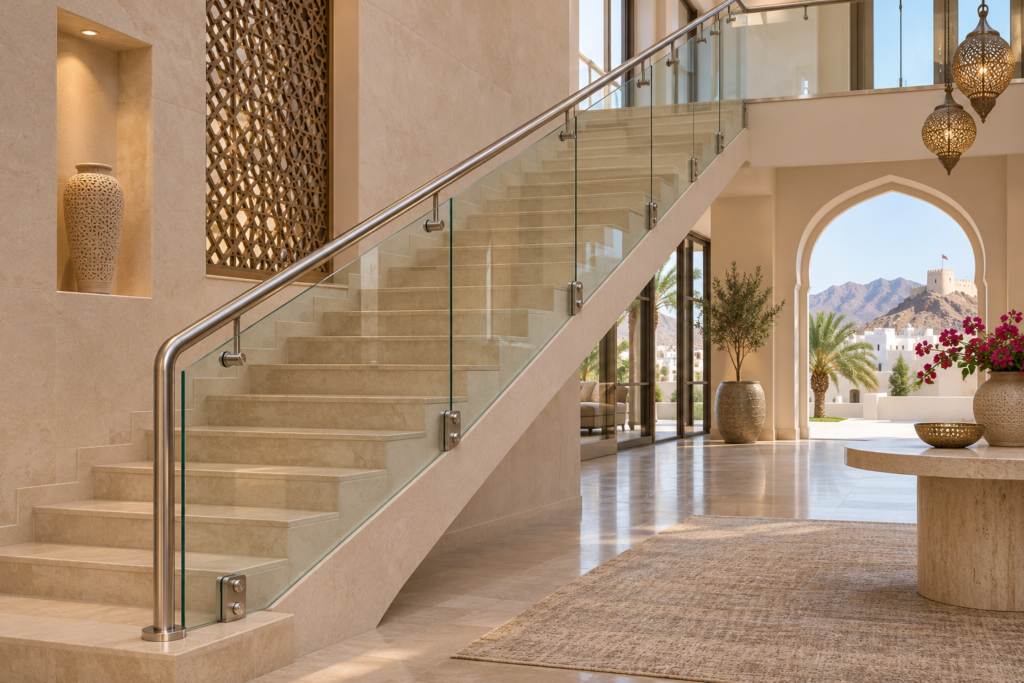
For an open-sided staircase, a glass balustrade with a stainless steel handrail can preserve the view across the stairwell and let daylight reach adjoining areas. This works particularly well in a double-height villa entrance where the staircase is visible from the living area. Glass Solutions offers several mounting options. The right choice depends on the stair layout, the supporting structure and where the fixings can be placed.
What Should You Check Before Ordering a Stair Handrail?
Before ordering stainless steel stair handrails in Muscat, walk the staircase from bottom to top and note where you reach for support. Look at the first step, any landing where the staircase changes direction, and the point where the handrail will end. Mark those spots on a photo so the supplier can review how the rail will follow the staircase.
If the walls are already tiled or clad in stone, tell the supplier what is behind the finish if you know. For a renovation, include photos of any existing brackets or fixing holes. For a new villa, share the planned wall and stair finishes so the handrail layout can be discussed before those surfaces are completed.
Ask for a finish sample before approving the order. Compare brushed and polished stainless steel next to the actual stair finishes and in the room’s lighting. A finish that looks subtle in a showroom may appear much more reflective beside a bright window.
What Affects the Cost of a Stainless Steel Stair Handrail?
Two staircases with the same number of steps can require different amounts of work. A straight run along one wall is simpler to plan than a staircase with multiple turns, landings and glass panels. The steel grade, rail profile, finish and mounting details all affect the quotation.
To get a more useful estimate, share photos from both ends of the staircase and approximate dimensions. Include the project location and mention whether the handrail will be indoors or outdoors. If you have a drawing, mark any turns, landings and open edges. These details help the team review the layout and discuss the options for your space.
Stainless Steel Stair Handrails in Muscat for Villas and Offices
Glass Solutions offers 304 and 316 stainless steel handrails in round and square profiles for residential and commercial projects. Depending on your staircase, you can discuss a standalone handrail or a system that combines stainless steel with glass.
Explore our Balustrade & Handrail Systems and contact Glass Solutions to share your staircase photos or drawings and request a quotation.